

Projektipäivät 2026 will take place on 20–21 October at Helsinki Messukeskus. This year’s theme is Back to the Future – The Future of the Project World? Proha is bringing a familiar project management topic to the event, one where there is still considerable room for development: risk management.
In a project, it is not enough to identify and record risks. From a management perspective, it is more important to understand what those risks mean for the project outcome. How much could the schedule realistically slip? How much could costs increase? What is the probability of different outcomes?
A Risk Register Does Not Measure the Degree of Uncertainty
In risk analysis, it is common practice to list risks, assess their impacts and probabilities, and consider possible response measures. The approach is familiar, but the danger is that risk management remains at a fairly superficial, basic level.
From a project management perspective, the more interesting questions begin only after this. If we know that a project will not be completed according to the original plan, how much is it likely to be delayed? Are we talking about two weeks or two years? If 100 million is invested in a project, what is the probability that costs will exceed a certain threshold? Risk analysis should be able to provide insight into precisely this scale of uncertainty.
There is an important distinction between risk identification and actual risk analysis. When uncertainty is examined quantitatively, probability distributions can be developed for project cost and schedule risks, making it possible to assess a range of potential outcomes. Risks are then no longer treated as a separate list, but their impacts can be considered as part of the project as a whole.
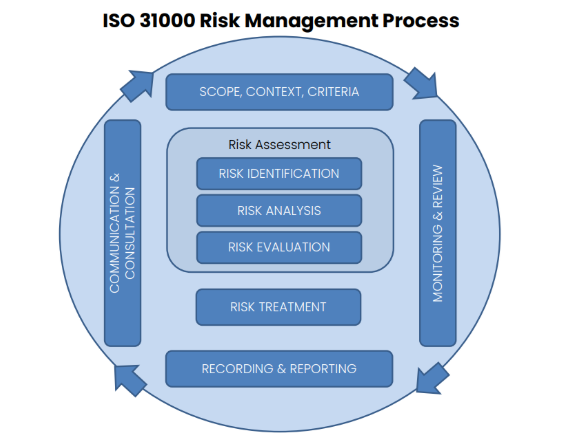
Image 1: The ISO 31000 risk management process highlights the continuous nature of risk management. In addition to identifying risks, they are analysed and evaluated, response measures are implemented, and risks are monitored throughout the project lifecycle.
How Mature Is Your Organisation’s Risk Management?
In Finland, project risk management often remains relatively superficial. Risks may be managed in Excel and a project may have a well-maintained risk register, but systematic risk analysis and quantitative assessment of impacts are not necessarily an integral part of project management.
It is therefore useful to think about risk management in terms of different levels of maturity. At the first level, risks are identified. At the next level, they are assessed more systematically. At a more advanced level, the analysis seeks to answer what kinds of project outcomes can be expected at different levels of probability.
This type of information is considerably more useful for management than a single risk percentage. It provides a basis for asking whether the project schedule is realistic, how much contingency is required, and what level of uncertainty the organisation is actually committing to in its decision-making.
Risk Analysis Is More Systematic in Norway
Norway provides an interesting point of comparison when it comes to risk management. More systematic practices have developed there for assessing risks in large, billion-euro projects, with project uncertainty examined quantitatively. Risk management does not stop at recording risks. The objective is to develop a better understanding of the range of cost and schedule outcomes that can be expected from a project.
This should raise an important question for Finnish project organisations: where does our risk analysis currently stand, and where should it be?
Particularly in large projects, this is not simply a matter of fine-tuning. When the value of a project is high, even seemingly minor uncertainties can have a significant financial impact. In such cases, a better understanding of the probability and impact of risks can also influence when decisions are made and what those decisions focus on.
Risk Management Starts Before the Project Begins
Risk management should also be considered from the perspective of the project portfolio and the wider business. In delivery projects, for example, a single poorly estimated workload or unfavourable contract can affect the financial performance of the entire business, even if the majority of the year’s projects are successfully delivered.
Risk management should therefore extend far enough upstream into the sales and contracting phases. The question is not only how risks in an ongoing project are monitored, but also how those risks can be influenced before the project has even started.
A more analytical approach also brings a strategic perspective to risk management. When an organisation has a large number of projects running simultaneously, it is important to understand not only the risks of individual projects, but also the overall risk exposure of the organisation and which investments carry the greatest uncertainty.
Proha’s Experts Bring Risk Management to Project Days
Projektipäivät 2026 will bring together project professionals at Helsinki Messukeskus on 20–21 October 2026. Proha will be part of the event, where the future of project management will be explored from a range of perspectives. At Projektipäivät, you will also have the opportunity to discover the new Camako 6.5 release and learn about its new features. Proha’s booth number and further details about the programme and schedule will be announced later.
From Proha’s perspective, there is still significant untapped potential in project risk management. Effective risk management requires expertise, but also tools that enable project uncertainty to be analysed more accurately and provide clear answers to support decision-making.
Projektipäivät offer an excellent opportunity to pause and consider one practical question: do we really understand what the risks in our projects mean? Risk identification is only the starting point. What matters is understanding how uncertainty affects project costs, schedules and outcomes, and bringing that information into decision-making.